

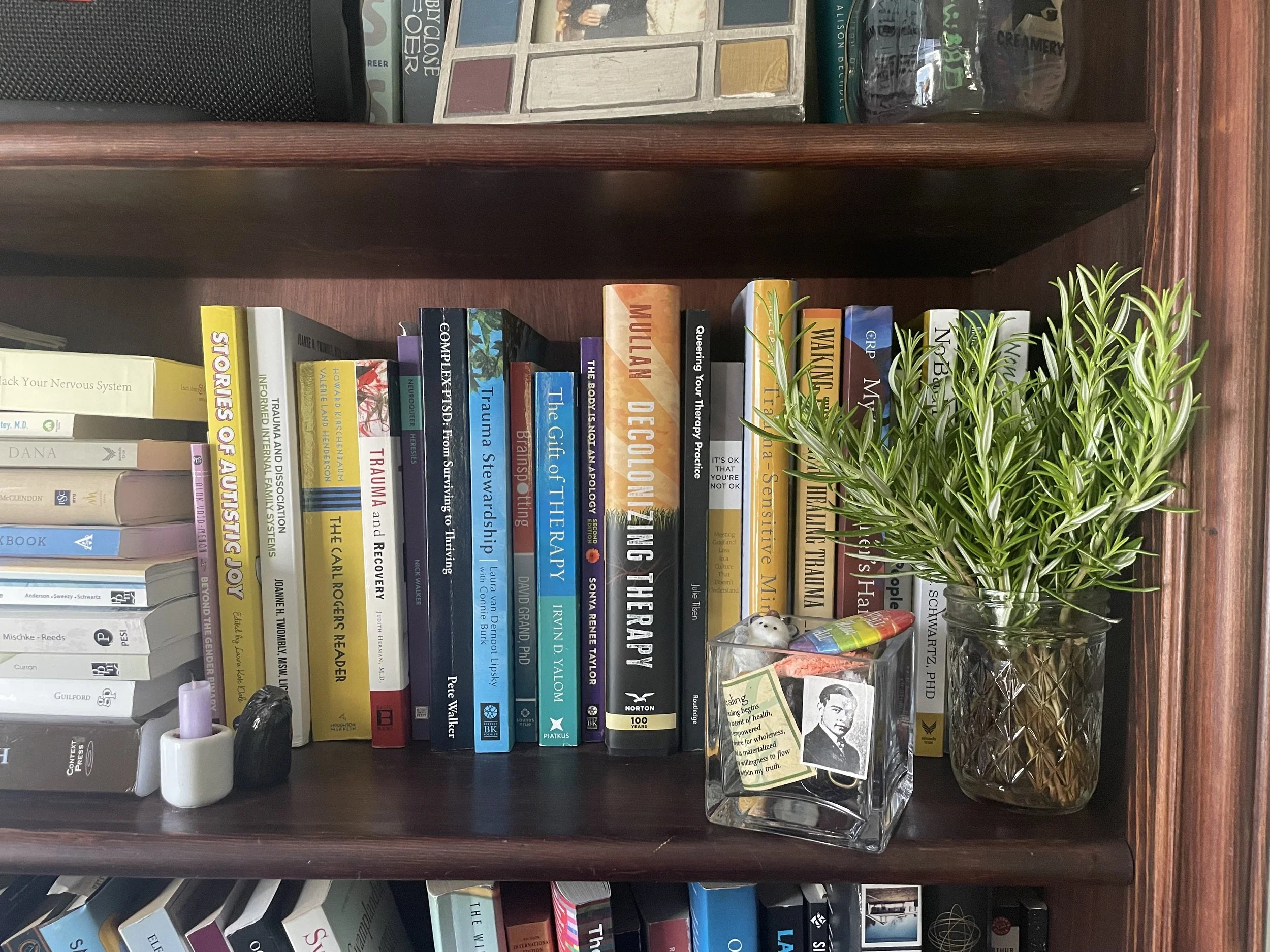
My approach
I like to think of therapy as a collaborative project—one that we work on together, but that ultimately belongs to you. So, let’s say we’re building something (whatever you want: a treehouse, a castle, a yurt, a garden shed). If I come in and insist on a fixed set of blueprints, they’re probably not going to fit what you actually want and need. So instead, my role might be to help you gather tools, steady the ladder while you climb, or hold up a lamp for you while you craft and repair.
In practice, that means we’ll both bring our tools into the room and figure out together what supports your goals. I find that prescriptive approaches don’t work well for most of my clients, so I work in a flexible, integrative way rather than using any one approach.
My work is grounded in relationship and shaped by a mix of humanistic, existential, and somatic perspectives. In sessions, I show up as a real person. You’ll find that I share my honest reactions and reflect what I’m noticing, and that I’m transparent about why I ask the questions I ask. I draw from narrative therapy and somatic approaches to support growth and trauma recovery. As a Social Worker, I’m always paying attention to how systems like capitalism, ableism, or white supremacy might be shaping your experiences.
Theories that inform my work include polyvagal theory, attachment theory, body liberation, and disability justice.
Some of my focus areas include:
Autism and ADHD (including late/self-diagnosis and unmasking)
Burnout and nervous system overwhelm
Trauma and complex PTSD
Chronic illness, disability, and health-related grief
Queer and trans identity exploration
Nonmonogamy and kink
Religious trauma or recovering from high-control environments
Relationship challenges, boundary setting, or healing from abuse
Intergenerational trauma and breaking generational cycles
Plurality, DID, OSDD, and other dissociative disorders
Therapy for Teens
Teen years and early adulthood can be especially challenging if you’re navigating a late diagnosis, a marginalized identity, or family or relationship challenges. I’ve supported teens with things like school stress, social anxiety, accommodations for school (high school/college) and identity exploration.
In Washington State, teens ages 13 and up can access therapy without the consent of a parent or guardian.
A note for parents and caregivers: Therapy for teens is most effective when autonomy and confidentiality are respected. My communication with you will be based on the needs and explicit preferences of your teen, and therapeutic goals will be determined by the client rather than their family.
Therapeutic Modalities
-
Brainspotting is a somatic therapy that helps process trauma, stress, and emotional blocks by using eye position to access deeper parts of the brain. It allows you to work through experiences that might feel hard to put into words, supporting healing at a nervous system level. I’m trained in Brainspotting Phases 1 and 2.
-
With narrative therapy, we’ll look at the stories you’ve been told/had to tell yourself and get curious about what shaped them. Family, culture, capitalism, systems of power. Narrative therapy aims to help you name harm and imagine a story that is better aligned with your values.
-
I don’t see neurodivergence as something to fix, but a natural part of human diversity. Many of the challenges we experience as neurodivergent people come from navigating a world that’s not built for us. I focus on accommodations, sensory supports, self-discovery and advocacy as important tools, and will support you in naming systemic harm as well as developing the best strategies for you to manage neurodivergent burnout and trauma.
Contact me
Interested in working together? Fill out some info and I’ll be in touch shortly to schedule a free 20-minute consult.
This form is not HIPAA-compliant. Please contact me at steph@neurorootedtherapy.com for more secure communication.